
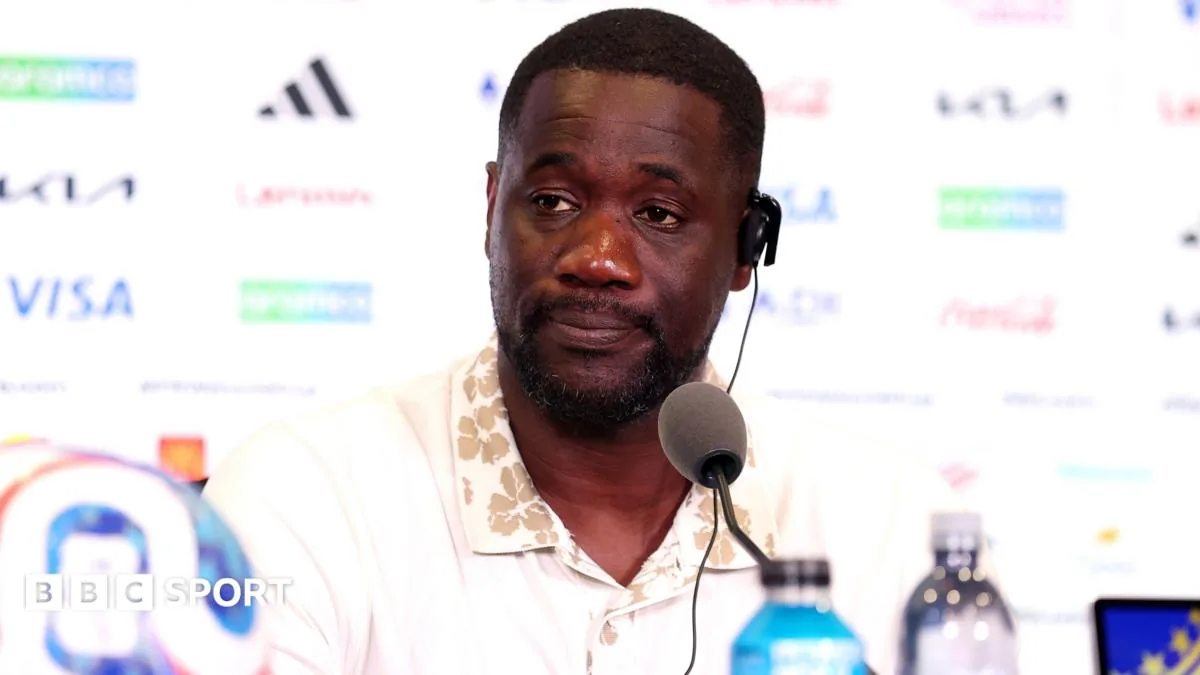
Emerse Fae, the manager of Ivory Coast, has indicated that remarks made by former Germany midfielder Bastian Schweinsteiger regarding his team’s playing style could be seen as racist. Schweinsteiger, acting as a commentator, described Ivory Coast’s approach as “a bit African football” and “not so conditioned by tactics” before Germany’s match against Ivory Coast in 2026 World Cup Group E.
Fae expressed disappointment with Schweinsteiger’s comments, particularly given his admiration for the former player. He suggested that such statements might stem from long-standing biases concerning African football. “I think it’s sad,” Fae stated after Ivory Coast’s victory over Curacao, which secured their progression to the knockout stages of the World Cup for the first time.
The Ivory Coast manager further elaborated on his feelings, saying, “Schweinsteiger was a very good player; I have always loved him as a midfielder and the way he understood football. When I heard his comments, I was disappointed in the man.” He added, “It is odd he would speak that way. We could call it racist, if we were calling a spade a spade.”
Fae maintained that he disagrees with Schweinsteiger’s assessment but intends to demonstrate through his team’s performance that African teams possess technical and tactical abilities beyond mere physicality. He expressed hope that the comments were merely clumsy rather than reflecting a deeper sentiment. Fae also speculated that Schweinsteiger’s remarks might have been intended to generate controversy and attract attention.
The comments were made during Schweinsteiger’s role as a pundit for German broadcaster ARD, ahead of Germany’s 2-1 victory over Ivory Coast on June 20. When asked about Ivory Coast’s style of play, he said, “A bit African football, a bit unorthodox, a bit wild, a bit perhaps also not so conditioned by tactics. We must be prepared for it to be unpredictable.”
These statements have already sparked debate within German media. Former Liverpool manager Jurgen Klopp declined to address the topic directly when questioned by journalists in New York while attending the World Cup. Klopp indicated the sensitivity of the subject, stating, “This is a serious subject, and I don’t even know what is appropriate to say.”
Debate on Stereotypes
Schweinsteiger’s analysis has led to accusations of employing racist stereotypes. Ahead of the Group E match in Toronto, which Germany won, his characterisation of Ivory Coast’s play as “a bit unorthodox sometimes, a bit wild, not quite as tactical” drew criticism. The 2014 World Cup winner had also advised Germany to be “prepared for it to be unpredictable at times.”
The remarks prompted significant reactions on social media and in German mainstream media, with critics suggesting that Schweinsteiger used colonial and racist tropes. These tropes, it was argued, reduce Black individuals to perceived physical attributes rather than acknowledging their intellectual capabilities. Schweinsteiger has not yet publicly responded to the controversy.
Philipp Awounou, a Black German journalist and author, highlighted the problematic nature of terms like “wild” and “unpredictable.” In a column for Spiegel news magazine, he explained that these stereotypes are deeply rooted in history, predating football, and carry racist, colonial origins. Historically, Black people of African heritage were often stigmatised as “uncivilised,” “different,” and potentially “dangerous.”
Sports content creator Patrick Schnitzler echoed these sentiments, referring to academic studies that indicate commentators and fans are more inclined to focus on the physical attributes of Black footballers compared to non-Black players. Schnitzler suggested that such stereotypes are learned within society, affecting individuals like Schweinsteiger and others.
Despite the strong criticism, Awounou clarified that he does not believe Schweinsteiger is racist, calling such a label “simply wrong.” He suggested that while the remarks were problematic, they might reflect broader opinions held by many German football fans and experts. However, Awounou noted that Ivory Coast’s performance against Germany did not align with Schweinsteiger’s characterisation.
Ivory Coast’s Performance
Contrary to Schweinsteiger’s comments, Ivory Coast delivered a tactically sound performance against Germany, particularly in the first half. They managed to push Julian Nagelsmann’s team wide and limit them to long-range shots and crosses. This was consistent with a team that had not conceded a single goal during the qualifying rounds and whose players largely feature in top European clubs.
Ivory Coast also demonstrated a threat on the counter-attack, with captain Franck Kessié scoring the opening goal following good work from Yan Diomande. Even after the break, the “Elephants” had opportunities to extend their lead, with Kessié and Amad Diallo combining for a chance that went over the bar.
After the match, Schweinsteiger acknowledged Ivory Coast’s performance on social media, stating that they were “the difficult opponent we expected and showed their technical quality and physicality.” He even suggested that Germany was the “wilder” team in that particular game. Awounou, in his Spiegel column, further pointed out that the most “unorthodox” player on the pitch, showcasing both physicality and technique, was not an Ivorian but Felix Nmecha, a German player of Nigerian roots.
This observation led Awounou to conclude that modern football has become too global for qualities to be determined by a player’s continent of origin or skin colour. Despite their loss to Germany, Ivory Coast advanced to the last 32 of the tournament with wins against Ecuador and Curacao in Group E. They are scheduled to play against France or Norway in the first knockout round on June 30 in Arlington, Texas.
Read Also
- India A vs Sri Lanka A: Sai Sudharsan's Century Dominates Day 1
- India faces selection dilemma with Sooryavanshi ahead of Ireland T20 series
- Pakistan's Gull Feroza reprimanded for breaching ICC Code of Conduct during Women's T20 World Cup
- Netherlands secure top spot in World Cup Group F with 3-1 victory over Tunisia
Source: bbc.com

Arjun Sharma
Sports Reporter