

White House defends players’ expression
The White House has publicly supported the right of Argentina‘s players to display a controversial banner regarding the Falkland Islands. This defence follows their World Cup semi-final victory over England and comes as FIFA continues to review a disciplinary case ahead of the final match against Spain. The comments were made during an official FIFA World Cup Task Force media briefing on Friday.
The briefing, primarily intended to provide updates on tournament operations, including security and preparations for the final in New Jersey, saw much of the discussion shift to the controversy surrounding Argentina‘s post-match celebrations. The incident occurred after Argentina‘s 2-1 comeback victory against England in Atlanta.
During a question-and-answer session, Sky News sports correspondent Rob Harris questioned Andrew Giuliani, Executive Director of the White House Task Force for the FIFA World Cup 2026, about the appropriateness of Argentina‘s players using a World Cup stadium for a political message. Giuliani, who is coordinating the federal government’s involvement in the World Cup, declined to criticise the players, instead referencing the United States Constitution.
Giuliani stated, “We believe in our First Amendment rights here in the United States of America.” He added that players have the “ability to do that in the United States of America.” Following the briefing, Harris noted that the White House supports the Argentina players’ right to protest about the Falklands at World Cup matches and rejects calls to punish them, viewing the issue through the lens of freedom of expression.
Controversy surrounding the banner
The incident involved several Argentina players holding a supporters’ banner that read “Las Malvinas son Argentinas” (“The Falkland Islands are Argentine”). This occurred immediately after their semi-final win. The Falkland Islands, located approximately 300 miles east of Argentina, are the subject of an ongoing sovereignty dispute.
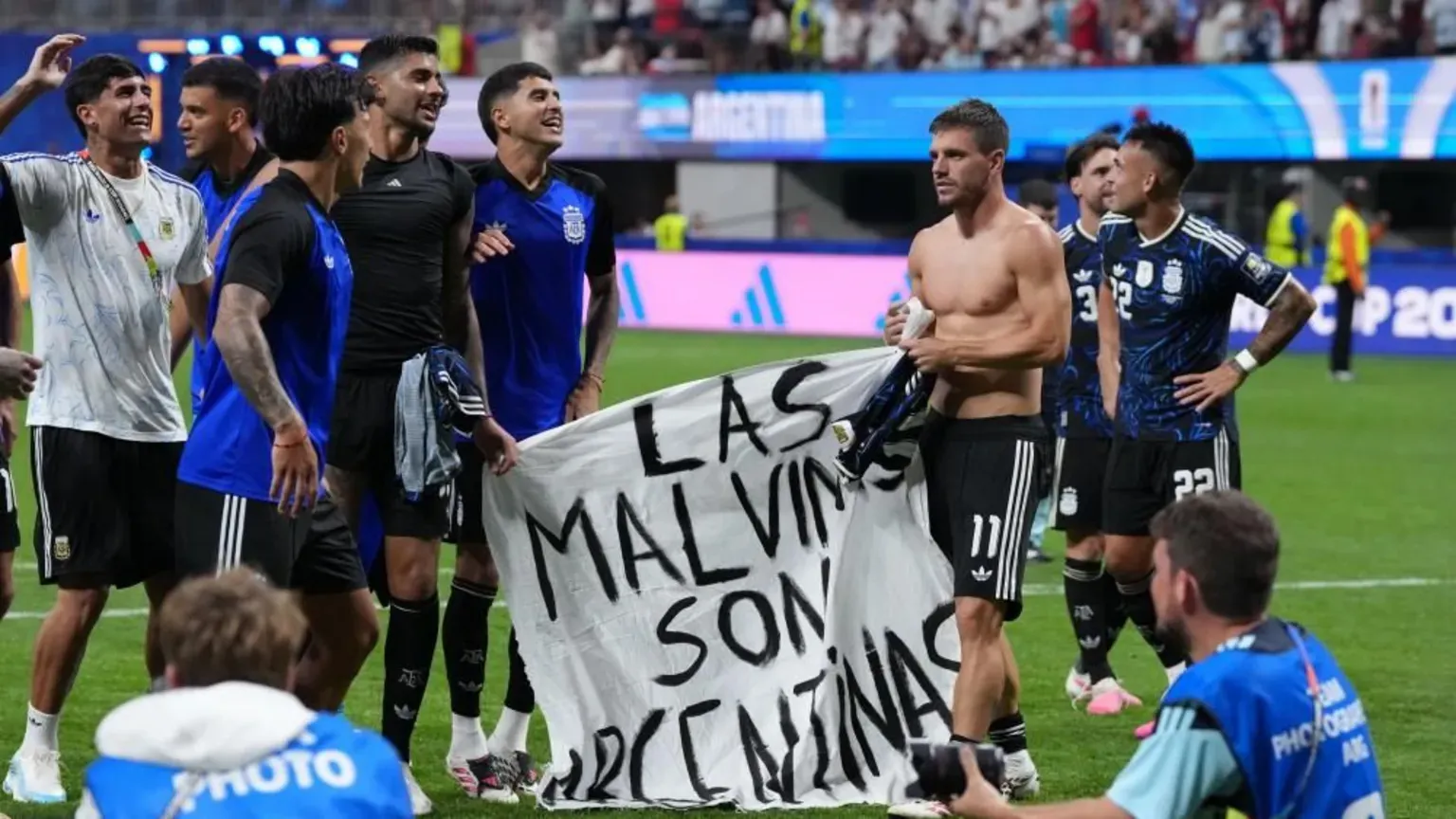
A conflict over the territory occurred in 1982 when Argentina invaded the islands, leading to a 10-week war before British forces retook control. The conflict resulted in the deaths of 255 British service personnel, 649 Argentine military personnel, and three Falkland Islanders. The sovereignty dispute remains a politically sensitive issue for both nations.
The government of the Falkland Islands expressed disappointment regarding the banner, hoping that FIFA would “sanction all behaviour of this nature in line with its own rules.” They emphasised a desire to keep politics out of sport and to avoid the islands being used as a “political football.” In 2013, a referendum saw the people of the Falkland Islands vote overwhelmingly to remain a UK overseas territory, with 1,513 votes in favour and three against, from a turnout of over 90%.
FIFA’s review process
Despite the White House‘s defence of free expression, FIFA‘s regulations take a different stance. Article 34.3 of the 2026 FIFA World Cup Match Protocol prohibits players and team officials from displaying political, religious, or personal messages before, during, or after matches. FIFA confirmed earlier in the week that its independent disciplinary committee has initiated its standard review process.
A FIFA spokesperson stated that the independent Disciplinary Committee is “assessing the match reports and considering the relevant circumstances before deciding on potential further steps based on the FIFA Disciplinary Code.” British politicians have urged FIFA to suspend the players involved. However, reports from Spanish and Argentine outlets suggest that any disciplinary action is more likely to result in warnings or financial penalties rather than suspensions. These reports also indicate that a formal decision is expected after the tournament concludes, though FIFA has not confirmed a timeline for this.
The initial briefing also addressed concerns about haze from Canadian wildfires affecting air quality in parts of the northeastern United States. Officials confirmed that contingency plans are in place, but there is currently no expectation that the World Cup final will be disrupted, with forecasts for East Rutherford predicting conditions well below the threshold for postponement or cancellation.
Read Also
Source: timesofindia.indiatimes.com

Arjun Sharma
Sports Reporter