
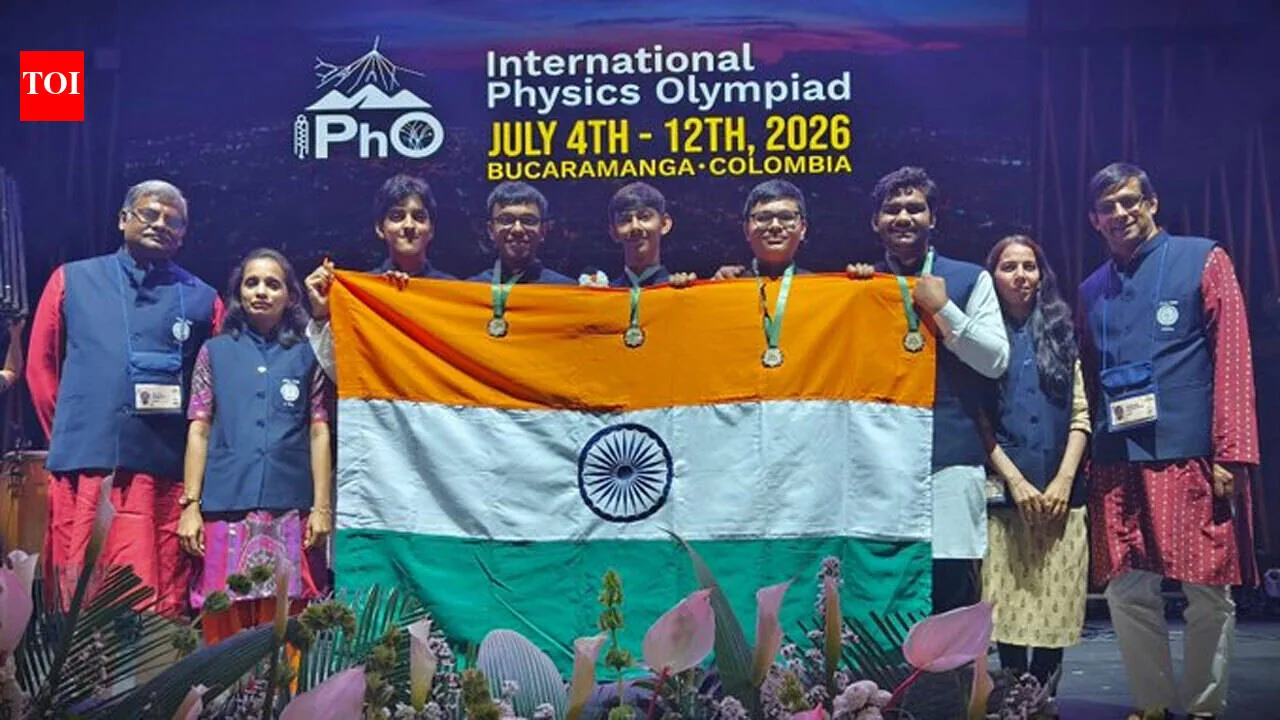
India has achieved a significant milestone at the 56th International Physics Olympiad (IPhO) 2026 in Bucaramanga, Colombia, with all five of its student representatives securing gold medals. This remarkable performance led to India being ranked joint World No. 1 alongside other nations such as China, Russia, Kazakhstan, South Korea, and Taiwan. This marks only the second occasion that India has achieved a clean sweep of five gold medals in the competition’s history.
The five students who earned gold medals are Kanishk Jain from Pune, Riddhesh Anant Bendale from Indore, Rishit Garg from Dwarka, Delhi, Shresth Suraiya from Mumbai, and Svarit Joshi from Ahmedabad. Their collective achievement was highlighted by Prime Minister Narendra Modi, who congratulated them on social media platform X, describing their performance as “outstanding.” The Prime Minister further noted that their success exemplifies the “limitless potential of our Yuva Shakti and their passion towards science and research,” and underscored India’s consistent exceptional performance at the International Physics Olympiad over the past decade, which he views as a testament to the country’s expanding scientific talent.
Rigorous Preparation and Unique Challenges
The success of the Indian contingent is attributed to extensive preparation and the unique demands of the International Physics Olympiad. The students underwent months of intensive training, which included advanced classes and laboratory sessions. Mentors such as Professor Anwesh Mazumdar and Dr. Leena Joshi, along with scientific observers Professor Ananda Dasgupta and Nisha Kelkar, provided crucial guidance throughout their journey. The Principal Scientific Adviser’s office also acknowledged their achievement, recognizing it as a demonstration of young Indian talent on a global scale.
The nature of the IPhO itself sets it apart from typical competitive examinations. According to product leader and former JEE Physics teacher Malay Krishna, the Olympiad involves a rigorous five-hour theoretical examination followed by another five-hour practical laboratory session. During the lab work, students are expected to design experiments, analyze data, estimate errors, and draw scientific conclusions using unfamiliar laboratory equipment. This format requires original thinking and a deep understanding of physics, rather than just speed or familiarity with question patterns.
Malay Krishna emphasized that the Olympiad demands a different kind of skill compared to entrance examinations. He noted that while coaching institutes are adept at preparing students for known question patterns, the Olympiad challenges participants with problems they have never encountered before. This necessitates a fundamental grasp of physics principles, as there are no shortcuts or formula sheets to rely on. His observations on social media resonated widely, highlighting the difficulty of the competition, which is considered one of the toughest academic contests globally.
India’s Consistent Performance and Future Outlook
India’s consistent strong showing at the International Physics Olympiad underscores the effectiveness of its publicly funded Olympiad ecosystem. This was India’s 27th appearance at the competition, and over the last decade, every Indian participant has returned with a medal, with a majority earning gold. The programme, coordinated by the Homi Bhabha Centre for Science Education (HBCSE), a National Centre of the Tata Institute of Fundamental Research (TIFR), identifies talented students through multiple stages of national-level examinations. These students then undergo rigorous training camps to form the final five-member team.
The Department of Atomic Energy (DAE) has also recognized this achievement as a reflection of the strength of India’s Olympiad programme. While the success in identifying and training scientific talent is evident, Malay Krishna also pointed out a broader challenge: encouraging these highly skilled individuals to pursue their careers within India. He observed that a significant number of Olympiad medallists often pursue doctoral research and subsequently build their careers abroad. The next step, he suggested, involves creating opportunities that incentivize these talents to continue their work within the country.
For now, the focus remains on the five young physicists whose extraordinary achievement has positioned India among the world’s best in a highly challenging scientific competition. Their success highlights India’s growing scientific prowess on the international stage.
Read Also
Source: timesofindia.indiatimes.com

Arjun Sharma
Sports Reporter