
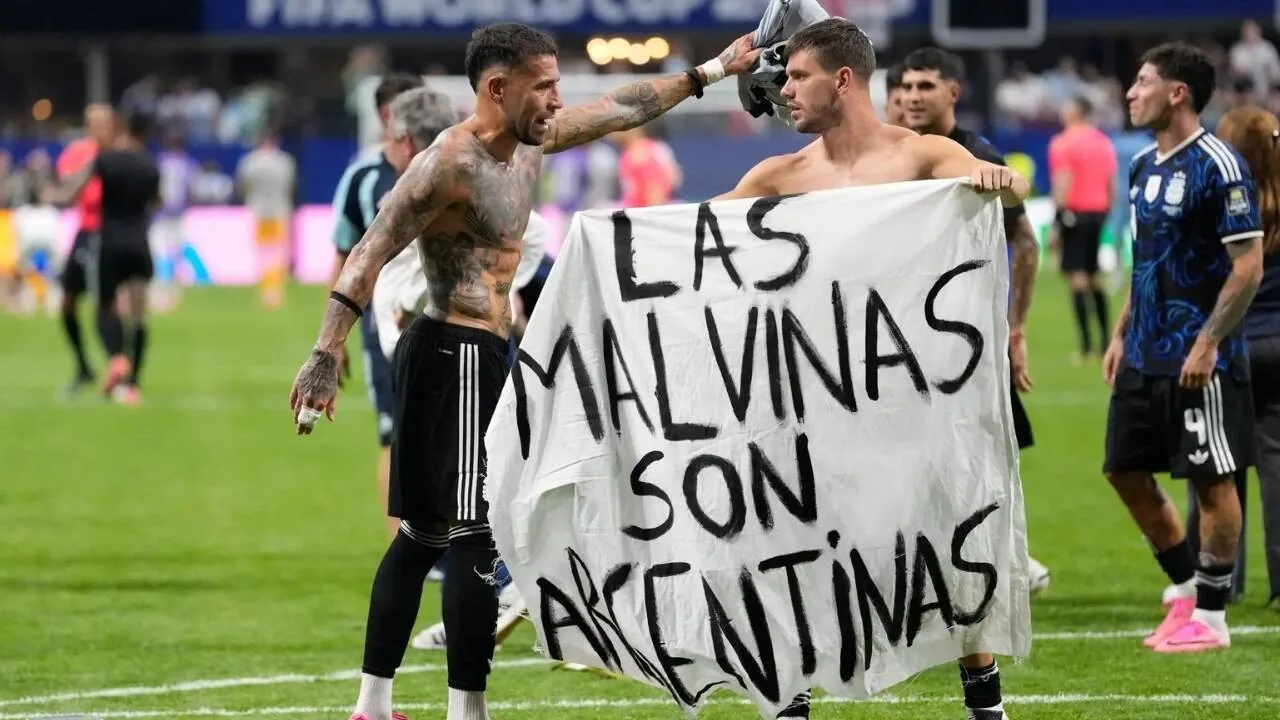
Following their 2-1 victory over England in the 2026 FIFA World Cup semi-final in Atlanta, players from Argentina displayed a banner that read “Las Malvinas son Argentinas” (“The Falkland Islands are Argentine”). This action has led to a disciplinary review by FIFA, just days before Argentina is scheduled to play Spain in the final.
The banner, which asserts Argentina‘s claim to the Falkland Islands (known as Islas Malvinas in Argentina), was seen held by players including Lisandro Martínez, Giovani Lo Celso, and Cristian Romero during post-match celebrations. Reports indicate that the banner may have originated from supporters in the crowd before reaching the players, despite previous measures to prevent fans from bringing Falklands-related flags and banners into the venue.
FIFA’s stance on political gestures
FIFA and the International Football Association Board (IFAB), which sets the rules for football, maintain a strict policy against political messages in the sport. IFAB rules specifically forbid equipment from carrying political, religious, or personal slogans, statements, or images. Additionally, FIFA’s Stadium Code of Conduct prohibits banners, flags, and other items of a “political, offensive, and/or discriminatory nature” within stadiums.
These regulations apply before, during, and after matches, both inside and around the venue. Violations can result in sanctions against individual players or the team by the competition organiser, national football association, or FIFA itself. FIFA‘s independent Disciplinary Committee is currently assessing match reports and other relevant circumstances to determine if further steps are needed under the FIFA Disciplinary Code.
The Falkland Islands government expressed disappointment regarding the banner, stating that it was an insensitive act, particularly given the history of the 1982 conflict. They urged FIFA to uphold its commitment to keeping politics out of sport and to sanction such behaviour in line with its established rules.

The issue of the Falkland Islands is rooted in a long-standing territorial dispute between Argentina and the United Kingdom. Britain reasserted control over the islands in 1833, while Argentina claims sovereignty from Spain after gaining independence in 1816, considering British control unlawful. The UK argues that the islands were uninhabited when discovered and settled, validating its claim.
The dispute escalated into the 1982 Falklands War, which lasted 74 days and resulted in over 900 deaths, including around 649 Argentine military personnel and 255 British soldiers. Britain continues to administer the islands and maintains a military presence. A 2013 referendum showed that the majority of Falkland residents voted to remain a British Overseas Territory, though Argentina continues to pursue its claim diplomatically.
Previous incidents and potential repercussions
This is not the first time Argentina has raised the Malvinas issue on the football pitch. In a 2014 friendly match against Slovenia, Argentine players displayed an identical banner. Following that incident, FIFA imposed a non-sporting sanction, fining the Argentine Football Association (AFA) approximately £19,540, though reported figures vary slightly.
Other instances of political gestures at World Cups have also led to sanctions. During the 2018 World Cup, Switzerland’s Xherdan Shaqiri and Granit Xhaka were each fined 10,000 Swiss francs for making an Albanian eagle gesture while playing against Serbia. In the 2022 World Cup, Serbia was fined 20,000 Swiss francs for a “No surrender” banner depicting Kosovo as part of Serbia.
While FIFA is reviewing the incident, no punishment has been confirmed at this stage. The incident highlights the deep connection between the Malvinas issue and Argentine national identity, both on and off the field.
The UK Prime Minister, Keir Starmer, supported the idea of FIFA investigating the players’ actions, endorsing a call from Peter Kyle, the business secretary, for FIFA to investigate potential rule breaches. Kyle described the banner as an “egregious violation of the rules of not having political activity as part of the football.”
A FIFA spokesperson confirmed that the independent disciplinary committee is assessing the match reports and relevant circumstances to decide on potential further steps in accordance with the FIFA Disciplinary Code.
The semi-final match itself was anticipated to potentially inflame disagreements over the Falklands. The UK rejected Argentina‘s complaint about the HMS Medway, a Royal Navy vessel, passing through its national waters, stating that the transit was in full compliance with international law and was a routine logistics visit to Chile between July 5 and July 8 to support British Antarctic Survey operations.
Argentina remains on course to face Spain in the World Cup final on Sunday.
Read Also
Source: vajiramandravi.com

Arjun Sharma
Sports Reporter