
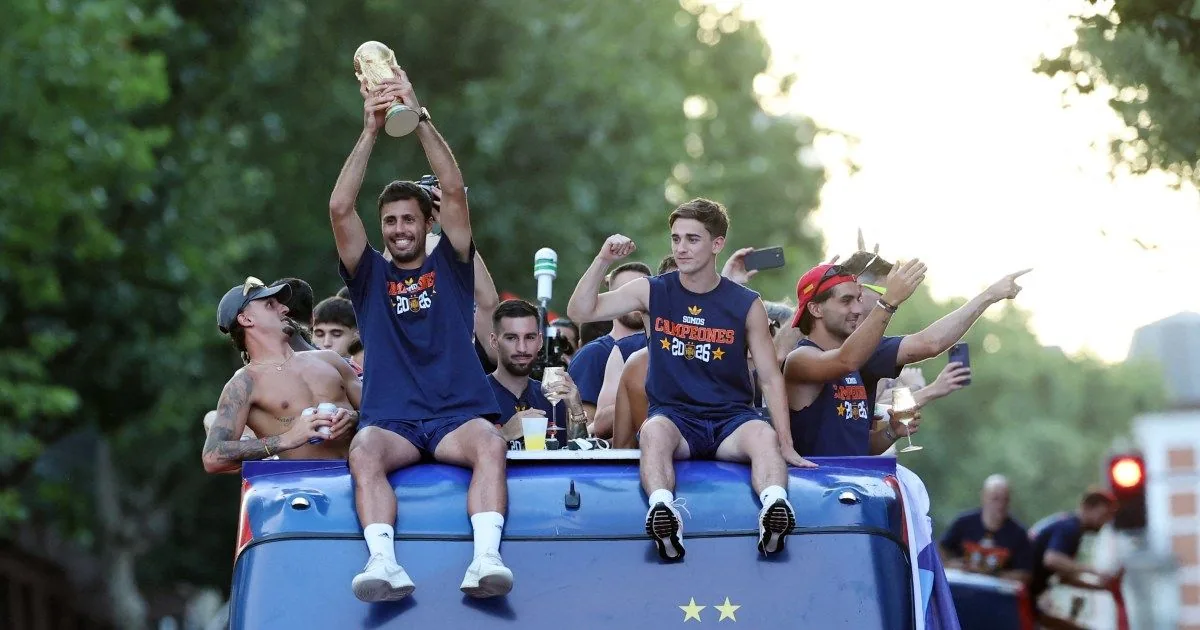
Spain’s triumphant return to Madrid
The Spanish national football team returned to Madrid following their World Cup victory, greeted by an estimated crowd of nearly 2 million people. The team, comprising 26 players and their coaching staff, first met with the country’s royals and Prime Minister Pedro Sanchez on Monday. This grand reception came a day after their 1-0 win against Argentina in the final, held in New Jersey, United States.
Prime Minister Sanchez commended the team, stating, “Thank you to the coaches and players for the style of play, the effort, and the victory.” He added that the nation truly enjoyed watching them play. Following their official engagements, the squad embarked on an open-top bus parade through central Madrid. The bus, adorned with “Stars shine together” and photos of the footballers, carried the World Cup trophy. Players, wearing shirts emblazoned with “Somos Campeones” (“We Are Champions”), danced and interacted with the enthusiastic fans lining the route.
Luis de la Fuente, the coach of Spain, expressed his joy before the parade, remarking, “It’s been an emotional and proud experience to represent a wonderful country with such passionate and devoted fans. We are filled with joy.” The parade route took the team from near Moncloa Palace, the prime minister’s official residence, to Cibeles Square. Authorities reported that approximately 120,000 people gathered at Cibeles Square for a ceremony, with some fans securing their spots early on Monday morning, using umbrellas to shield themselves from temperatures reaching up to 35 Celsius.
Cibeles Square is a traditional celebration spot for Spain‘s national teams and Real Madrid. Singers Aitana, Ana Mena, and Lola Índigo were scheduled to perform for the crowd at the ceremony. Officials estimated that around 1.8 million people welcomed the team across Madrid. Spain secured their second World Cup title, and their first since 2010, with Ferran Torres scoring the winning goal in extra time on Sunday.
The team received congratulations from the co-hosting nations’ leaders: US President Donald Trump, Mexican President Claudia Sheinbaum, and Canadian Prime Minister Mark Carney. Following the final whistle, Madrid erupted in celebrations, with thousands of supporters pouring into the streets from bars and restaurants. Many were draped in Spanish flags or wore the team’s colours, filling major squares like Puerta del Sol with singing, dancing, and flares, while car horns blared. Celebrations continued into the early hours of Monday morning.
Victor Alvarez, a 19-year-old fan, commented on the festivities, saying, “I’m very happy. I’ve slept three or four hours, but for the team, I’ll do whatever it takes.” This men’s victory, combined with Spain‘s win in the Women’s World Cup in 2023, makes Spain the first European nation to hold both titles simultaneously. Gema Rodero, a 59-year-old civil servant, shared her experience: “Honestly, it was very exciting. We preferred not to go to any bar or anything, to experience it at home, focused and very happy, very joyful.”
Final match analysis and Messi’s future
While the World Cup was largely considered incredible, the final match itself was described by some as frequently tedious for many viewers. The game saw Spain defeat Argentina 1-0, with Ferran Torres scoring in the 106th minute. Argentina‘s game plan was scrutinised, as statistics suggested they were largely outplayed, seemingly relying on defensive tactics in hopes of a break or penalties. Spain, on the other hand, maintained their characteristic possession-based play, limiting risks.
The outcome of the final was seen by some as a victory for the “right team” and the “more honest group of players.” The extended half-time show during the final also drew criticism, with suggestions that it was primarily for advertising revenue rather than enhancing the fan experience or player well-being. Concerns were raised about the potential for injury due to players stiffening up during the prolonged break, particularly older players like Lionel Messi.
Messi had a quiet match against Spain, leading to questions about his future participation in the World Cup. While one quiet performance does not signify the end of his career, there is speculation about whether he will feature in another tournament to avoid tarnishing his legacy. The discussion around Cristiano Ronaldo‘s recent return to the World Cup stage, which some viewed as a hindrance rather than a positive, adds to this debate. The final also saw Enzo Fernandez receive a red card, which some observers felt was a fitting downfall for Argentina‘s tactics.
The World Cup final was preceded by a bronze medal match between England and France, which was described as a classic, ending with a score of 6-4. This contrast highlighted the differing approaches to play, with the third-place playoff demonstrating a fearlessness and willingness to try various tactics, unlike the more cautious approach seen in the final. Despite the excitement of the bronze medal match, it is suggested that such fearlessness is only possible when the outcome is not as crucial as in a final. The Spanish national team‘s victory marks a significant moment in football history, bringing their second World Cup title home on Sunday.
Read Also
Source: aljazeera.com

Arjun Sharma
Sports Reporter