
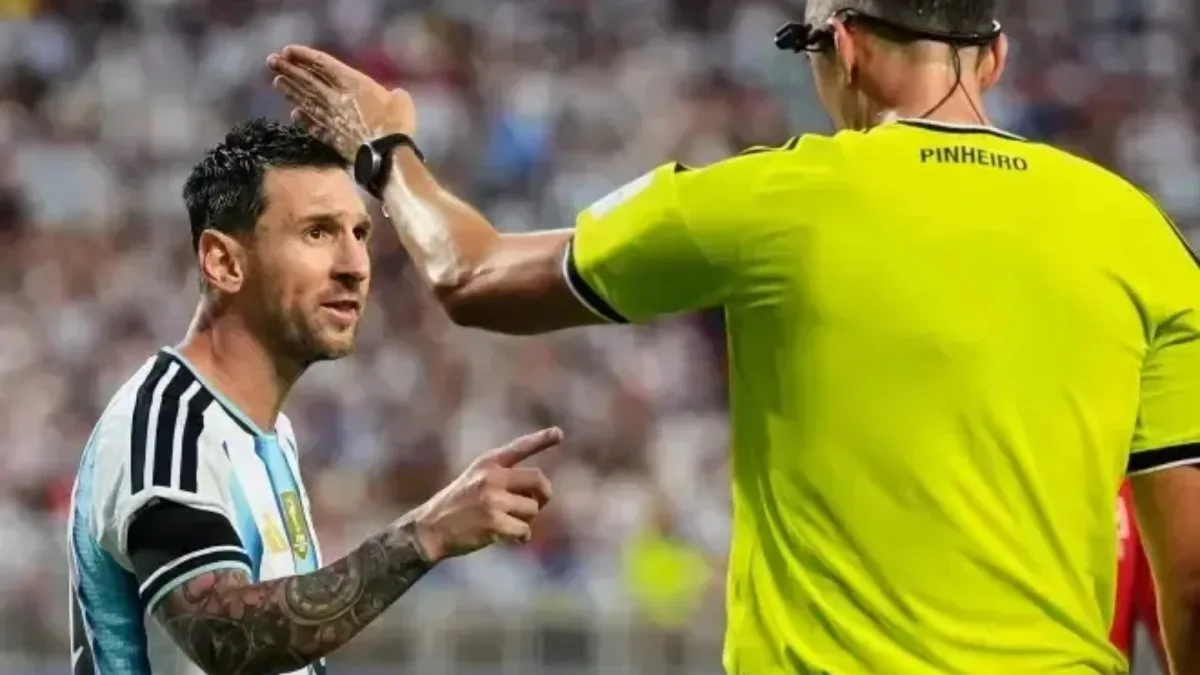
FIFA’s Stance on VAR Intervention
FIFA has publicly defended the decision to send off Switzerland’s Breel Embolo during the 2026 World Cup quarter-final match against Argentina. The global football governing body stated that the intervention by the Video Assistant Referee (VAR) technology in the incident was consistent with an approved interpretation of the “mistaken identity” clause. This defense comes despite the controversy surrounding the incident and comments made by the International Football Association Board (IFAB).
A spokesperson for FIFA, quoted on the platform “X” via FIFA’s official account, elaborated on the organization’s position. The spokesperson indicated that FIFA’s interpretation of mistaken identity was applied uniformly throughout the World Cup. They highlighted two instances where a player was incorrectly identified as having committed an offense warranting a yellow card. In these cases, the video referee advised the main referee to rectify the factual error that resulted from an opponent’s simulation.
The spokesperson further clarified that the simulation itself cannot be questioned and should not lead to a disciplinary sanction against an opponent that could have additional consequences. Such consequences might include a sending-off due to a second yellow card or a suspension resulting from the accumulation of cards. FIFA does not view this as an error by either the referee or the Video Assistant Referee, asserting that the decision was a correction made in the interest of justice.
FIFA also acknowledged IFAB’s comments, which were contained in its circular, and confirmed ongoing communication with them. According to FIFA, IFAB has affirmed that this interpretation is correct and has been well received. This interpretation is also expected to be part of future discussions concerning the review of the VAR technology protocol, a topic that was previously addressed at the last annual general meeting.
The Embolo Incident and Referee’s Perspective
The incident involving Embolo occurred early in the second half of the quarter-final between Argentina and Switzerland. Embolo went down without any contact from Leandro Paredes. Initially, Portuguese referee Joao Pinheiro awarded a foul against the Argentine player and issued him a booking. However, the video referee subsequently intervened. After reviewing the play, the video referee determined that Embolo had simulated being fouled. As a result, Paredes’s caution was rescinded, and the card was instead issued to the Swiss forward. This was Embolo’s second yellow card of the match, leading to his sending-off in the 72nd minute.
At the time of the red card, the score was level at 1-1. Argentina capitalized on having an extra player, scoring two goals in extra time to secure a 3-1 victory and advance to the semi-final. A similar situation had previously occurred during the group stage match between Paraguay and the United States, where Paraguay’s Miguel Almiron also received a caution for attempting to deceive the referee.
Referee Joao Pinheiro later discussed the controversial sending-off, explaining his initial interpretation and the subsequent VAR review. He stated that his officiating team initially believed an offense worthy of a booking had been committed by the Argentine player. However, the review clearly showed no foul and confirmed that the opponent had simulated contact. Pinheiro noted that because it was Embolo’s second yellow card, it resulted in a sending-off, adding that the decision would have been the same even if it had been the first yellow card. He viewed the changes introduced by FIFA to correct such actions positively.
Dialogue with Messi and Match Control
The quarter-final match also featured a notable exchange between Pinheiro and Lionel Messi. Cameras captured the Argentina captain asking the referee to speak to him respectfully. Pinheiro downplayed the incident, describing it as a routine exchange on the pitch. He explained that Messi, like other players, raised issues with him, and that captains frequently engage with referees, a practice allowed by new rules. The referee believes that Messi’s prominence amplified the visibility of this interaction, noting that such situations are often perceived differently when involving players like Messi or Cristiano Ronaldo.
Far from considering these conversations detrimental, Pinheiro believes they contribute to controlling matches without the constant need for issuing cards. He described these dialogues as healthy, suggesting that not every interaction requires a caution. He acknowledged that Messi might have misinterpreted something he did, but through discussion, they understood each other and moved on. Pinheiro also expressed his appreciation for his participation in the World Cup, which marked the return of a Portuguese refereeing team to the final stage after a twelve-year absence, and thanked Pedro Proença, the president of the Portuguese Federation, for his support throughout the tournament.
Source: goal.com

Arjun Sharma
Sports Reporter